
What the AlignFive game rules are trying to achieve
The goal is to build connected lines of five markers on the board. A line can be horizontal, vertical, or diagonal. In most two-player or two-team AlignFive game rules, the first side to complete two Runs wins. In most three-player or three-team games, one completed Run is enough to win.
A completed Run locks in most of its markers. Opponents can still block future lines, but they usually cannot remove a marker that is already part of a completed Run. That timing detail matters because a move that finishes one line can also protect the key spaces you need for the next one.
Quick rules
- A Run is five connected markers in a row.
- Lines can be horizontal, vertical, or diagonal.
- 2-player and 2-team games usually need 2 Runs.
- 3-player and 3-team games usually need 1 Run.
Setup and turn order
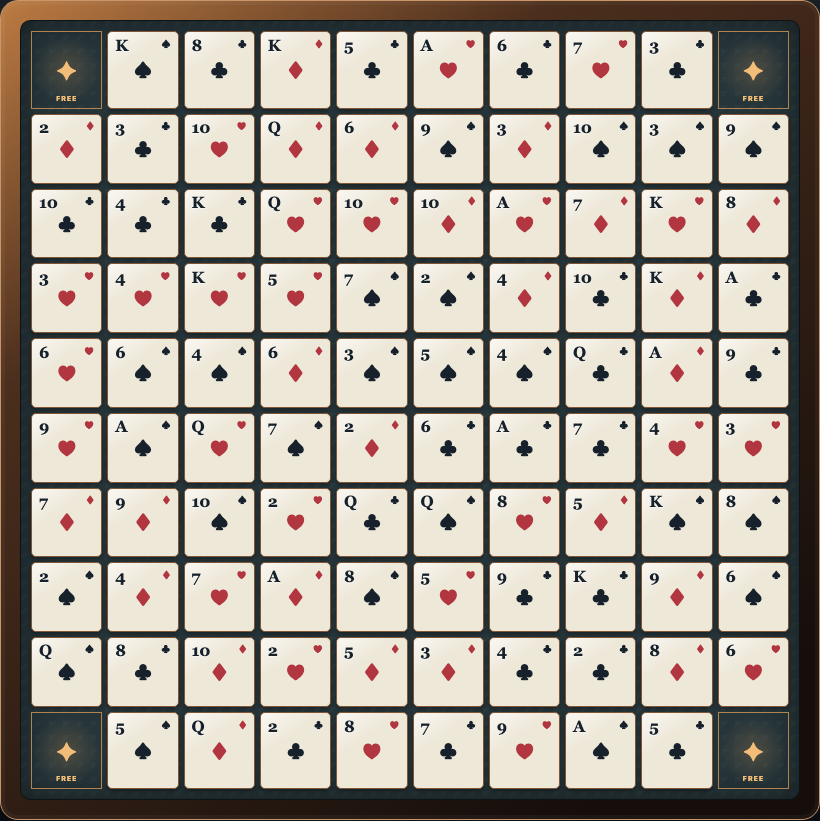
Players shuffle the deck, deal hands, choose marker colors, and place the board where everyone can see it. The exact hand size can vary by edition and player count, but the turn pattern stays the same: play one card, place or remove one marker if the card allows it, then draw back up.
Most cards appear twice on the board, so one card often gives you two legal spaces. That is one reason rules for playing AlignFive feel more strategic than simple luck. Each turn is a choice between extending your own line, blocking an opponent, or claiming a space that could matter later.
Quick rules
- Choose marker colors before play starts.
- Teammates should be spaced evenly in turn order.
- Play one card, place or remove one marker, then draw back up.
- Most cards have two matching board spaces.
How each turn works
On your turn, choose a card from your hand and place one of your team's markers on a matching open space. Because most cards appear twice on the board, you usually have two possible locations for the same card. After placing a marker, draw a replacement card so your hand stays stocked.
The best move is rarely just the first matching space you see. Look for spaces that extend your line, stop an opponent's four-in-a-row, or create two possible Runs at once. Rules for playing AlignFive board game rounds are simple, but strong decisions come from board reading rather than rushing.
Quick rules
- Play a card only if a matching board space is open.
- Choose the space that builds your line or blocks a threat.
- Draw a replacement card after your move.
- A card can become dead when all matching spaces are occupied.
Jacks, corners, and protected markers
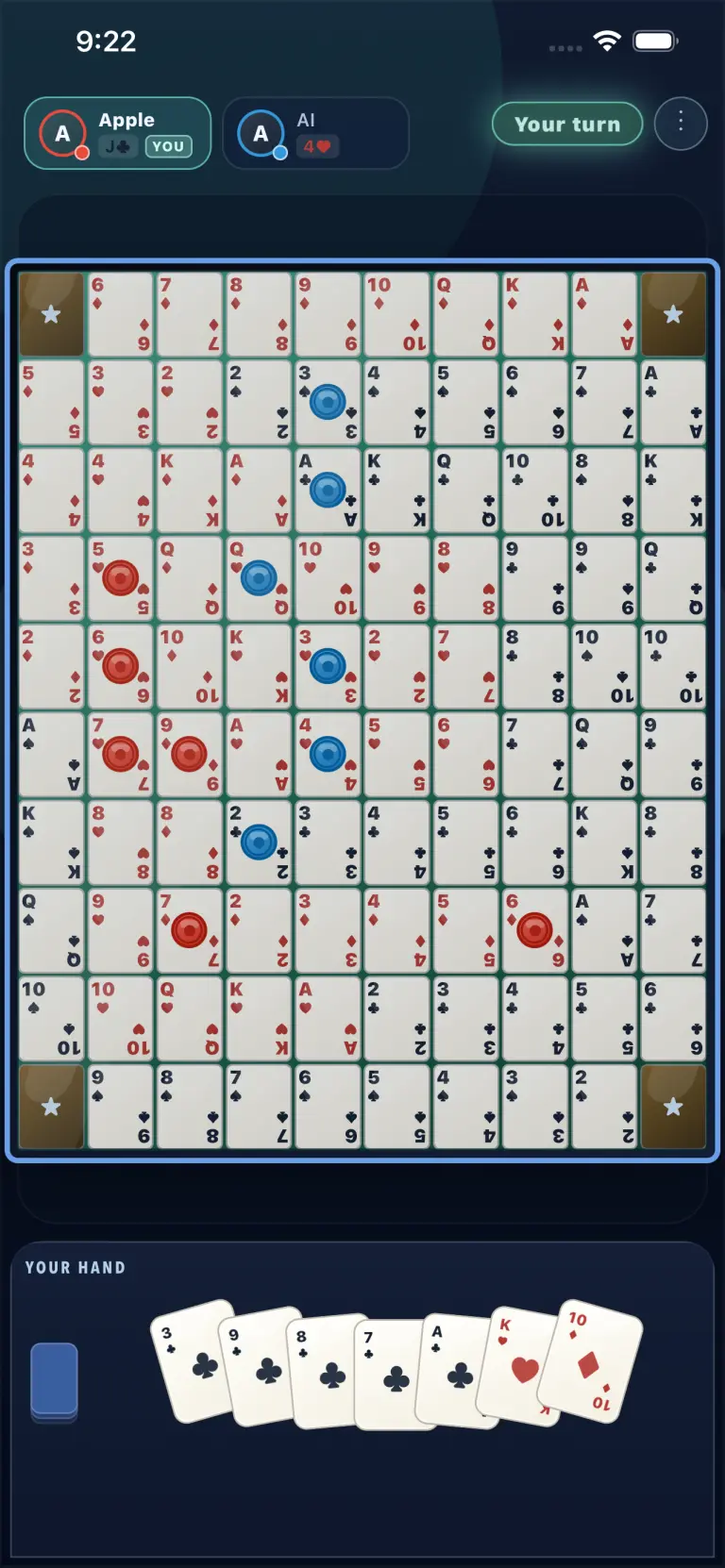
Open Jacks can place a marker on any eligible open non-corner space, which makes them the most flexible cards in the game. Strike Jacks remove an opponent's marker as long as it is not protected inside a completed Run.
The four Free Corners count for every side and can complete Runs without requiring a marker. Once a Run is completed, its protected markers cannot be removed by a Strike Jack.
Quick rules
- Open Jacks place a marker on any open non-corner space.
- Strike Jacks remove an opponent marker.
- Protected Run markers usually cannot be removed.
- Free Corners count for every side.
Dead cards and edge cases
A card is dead when every matching space for that card is already occupied. In many home versions of card-matching board games, a dead card can be revealed and replaced according to the table's agreed rules or the printed insert for that edition. In AlignFive, the app can prompt for a dead-card replacement so you are not stuck holding a card that can never be played.
Dead cards also tell you something about board pressure. If many spaces are locked, the game is shifting from open development to tactical blocking. In that phase, Jacks, corner lines, and short defensive moves become more valuable than long, speculative builds.
Quick rules
- A dead card has no open matching board space.
- Dead-card replacement depends on the rule set or app prompt.
- Late games create more dead cards and blocked spaces.
- Jacks become more valuable when the board is crowded.
Player-count variants
Two and four players are the most common setups. With two players, each player controls a color directly. With four players, partners usually sit opposite each other and work as two teams. In both setups, the common win condition is two completed Runs.
Three players can be played as individuals, and six players usually becomes three teams of two. In those larger variants, many groups use one completed Run as the win condition because the board fills faster and blocking pressure rises. If your physical set lists a different deal size or win target, follow the rules for that edition.
Quick rules
- 2 players can play head to head.
- 4 players usually play as 2 teams.
- 6 players usually play as 3 teams of 2.
- Follow your edition's printed rules when it differs.
Common questions
What are the basic AlignFive rules?
Play one card from your hand, place a marker on a matching board space, draw a replacement card, and try to complete lines of five markers before your opponent or opposing team does.
How do Jacks work in AlignFive?
Open Jacks place a marker on any open non-corner space. Strike Jacks remove an opponent's marker unless that marker is already protected inside a completed Run.
How many players can play AlignFive?
The most common setups are 2, 3, 4, and 6 players. Two and four players usually play to two completed Runs, while three-player and three-team variants often use one completed Run as the winning target.
Do you have an official AlignFive rules PDF?
No. This site explains the rules used in AlignFive and summarizes the standard game flow, but it does not host or claim to provide an official publisher PDF download.
Where should I start if I only need a quick version?
Start with the quick how-to-play guide, then return to this full rules page if you need details on Jacks, dead cards, or player-count variants.
Need the short version?
Open the quick how-to-play guide for the fast explanation, then come back here for the full rules, Jacks, and player-count details.
AlignFive strategy for beginners
Learn beginner AlignFive strategy with practical tips for board control, blocking, Jacks, corners, team play, and how to win more games.
AlignFive Jacks rules and strategy
Learn AlignFive Jacks rules and strategy, including how Strike Jacks remove markers, how Open Jacks provide flexible placement, and when to play them.
AlignFive team strategy
Learn AlignFive team rules and strategy for partner support, readable threats, shared blocking, team turn planning, and coordinated online play.
Blocking strategy in AlignFive
Improve your AlignFive defense with blocking strategy for open fours, forks, board control, defensive Jacks, and pressure-building blocks.
Play AlignFive online with friends in private rooms
Play AlignFive online with friends using private rooms, room codes, teams, rematches, and smooth game setup in AlignFive.
Play AlignFive against the computer
Play AlignFive against the computer in bot practice to learn the rules, test strategy, understand Jacks, and prepare for online multiplayer games.